MAPA
Every engagement starts with a map.
Before any tool, we locate where your business loses value, who owns it, how the work should change — and under which rules AI may run.
For owners and operators · Miami · English and Spanish
Why a map first
I have spent more than twenty years operating businesses — a $100M vehicle distributor with a thousand people, a franchise network of more than a hundred locations, a hospitality platform of two hundred units, and today the four businesses of AKA. In every one of them, the expensive problems were never where the software demo pointed.
They were in handoffs nobody owned, in data that arrived too late to matter, in decisions that had an outcome but no owner. So before we ever talk about AI, we make a map.
— Fabian J. Ortega A., founder
The route: four phases, each closed by a gate nobody skips.
Including us. Open each phase for what happens, what you take away, and the gate that closes it. The detail — every instrument and template — lives in the Manual.
MMap the lossWhere does this business lose value — measured, not assumed?
We interrogate the work as it actually happens, not as the org chart says it happens: six questions, pushed past the symptom until the answer names the condition producing the problem. Every loss gets coordinates on the nine elements where work can break — from roles and handoffs to data, timing and accountability — and a confidence state. Missing evidence never stops the map and never gets invented: it is logged as a gap, with what it blocks and who unblocks it.
The loss map: one page per loss — its cost, its coordinates, who suffers it, since when — plus the gap register.
Every loss has a figure or is honestly marked as a question. Nothing is “estimated.”
Framing — what problem, for whom?
AAssign an ownerWho owns each loss — with the authority to change what produces it?
Every loss gets one named owner — and we check the thing most diagnostics skip: whether that person has the authority to change what produces the loss. A target being met is not proof the system works; it is often the measure of someone’s heroics compensating for it. Both the authority gaps and the masking workarounds go on record, and the decision ledger opens: every decision the engagement takes or defers gets an ID, an owner, a deadline and the cost of not deciding.
The owner table — one named person per loss, their real authority, the workarounds found — and the opened decision ledger.
No loss without an owner. If nobody can own it, we don’t build anything for it.
Accounting — who answers for it?
PPlan the workHow should the work happen — with or without AI — and which work first?
Before any tool is named, we redesign the work on paper and ask what capability the problem actually requires — description, explanation, prediction, recommendation, or generation. Many losses close right here, without AI: a sequence fix, a role fix. And because hours are the scarcest resource in an operator-led company, nothing gets ours — or yours — on a hunch: every candidate intervention is scored on our own impact model before it starts, ranked by expected value, and committed to in writing with its metric, its baseline and its kill criterion set in advance. Three initiatives active at most; one income priority at a time.
The redesigned work on paper, plus the scored, ranked portfolio — at most three committed initiatives, pre-registered.
The owner approves the redesign before a single tool is chosen — and no score, no hours.
Orienting — what capability?
AAutomate under rulesWhat runs, what does it decide alone, what stays with a person — and how will we know it worked?
Only now does AI enter, and it enters contained. We write the rulebook first: what the system may decide alone, what stays with a person, what it must never touch, what gets logged, and what fails closed. Any step that would combine untrusted input, sensitive data and the power to act on the world gets a human in the loop — no exceptions. Every automated action starts low on an autonomy ladder and earns each level with evidence; anything irreversible never runs without approval.
The rulebook: every action classified into zones, the approval contract, the kill switches, the blocked list, and the success metrics with their baselines.
The rules are written and approved before the first agent runs. No exceptions — our own systems included.
Judging and accounting — is it working, and who answers?
After the route: verified operation.
The system lives under the same compass we used to build it, reports in three states, and its autonomy moves one level at a time — in both directions. Autonomy is earned, never assumed.
The autonomy ladder: one level per four clean weeks, demotion on any incident. Irreversible actions cap at level 2 without approval.
- ✓Verified — confirmed against the log or the receiving system, not the agent’s self-report.
- ○Last known — true at a stated date, not reconfirmed since.
- ?Open question — honestly unknown. Never enters a sum, never averaged away.
Four readings, taken at every point of the route.
Governance is not a gate at the end — it is a thread through the whole engagement. Four readings, each a question with a named answer.
What problem is this solving, and for whom?
What capability does it actually require?
Is it working, against the criteria we set?
Who answers for it?
The four readings come from the governance framework of Boston University’s MS in AI in Business.
Five written documents. Not slides.
Every engagement leaves instruments you keep and your own software can enforce — not a deck that ages in a drawer. Below, a sample page of each kind, with fictional data.
- The loss mapOne page per loss: cost, coordinates, who suffers it, confidence state.
- The owner tableOne named owner per loss, with their real authority checked.
- The redesigned workThe future state on paper, human/AI boundary drawn, approved by the owner.
- The rulebookWhat runs alone, what needs a person, what is blocked outright.
- The operation boardThree states, costs, autonomy levels and open questions — alive after we leave.
The sample pages
| Cost | State | Coordinates |
|---|---|---|
| $9,400 / month in lost orders | ✓ measured | Handoffs · timing · accountability |
| Hours lost chasing approvals | ? open question | Roles · judgment points |
Structural answer: quotes wait on a price check only one person can give.
| Loss | Owner | Authority | Workaround found |
|---|---|---|---|
| L-03 · late quotes | Operations lead | Can change pricing rules: yes. Can change staffing: no — flagged. | Sales re-checks every price by phone; target still met, by heroics. |
Accountability without authority is itself a finding.
| Metric | This week | State |
|---|---|---|
| Quotes answered same day | 41 of 44 | ✓ verified |
| Cost per quote drafted | $0.18 | ✓ verified |
| Reply rate on reminders | as of Oct 3 | ○ last known |
| Why Tuesday dipped | — | ? open question |
Autonomy this week: drafting at level 3 · sending at level 1.
Three ways to work with us.
Each one ends with documents you keep, whoever you build with afterwards. Scope and fee are agreed in writing before we start.
We locate where the business loses value and who owns it, before you decide anything.
- The loss map, with every figure sourced or marked
- The owner table, authority checked
For the owner who wants to know where value is lost before committing to anything.
The complete method: map, owners, the work redesigned, and the rules written.
- All five documents
- The rulebook, approved by you
- The scored portfolio: at most 3 initiatives, 1 income priority
For the owner who is going to implement.
The route, running: the operation board with its three states, the weekly ritual, and autonomy earned one level at a time.
- The operation board, alive
- The weekly truth session
- The autonomy ladder, enforced
For the owner who has walked the route.
From your message to a decision — in the open.
- 1A first call
Thirty minutes. How the business runs, where you suspect value is lost, whether a map makes sense.
- 2Written scope
What we will map, how long it takes, what we need from you — agreed before any work starts.
- 3The map
The work interrogated where it happens; every figure sourced or marked as a question.
- 4The readout
The map read with you, the owner — losses, owners, and what they mean.
- 5Your decision
Continue to the route, stop, or change course. The map is yours either way.
What we need from you — and what we don’t do.
A diagnostic is only as honest as its access. These terms are why the map comes back true.
- Access to the real work and the people who do it — not only the org chart.
- An owner with the authority to decide, on your side.
- The data you already have, even if it is messy. Finding out what it is worth is part of the map.
- Tool demos before the map.
- Promises of results without a way to measure them.
- Projects with no owner on the client side.
- Automating the irreversible without explicit approval.
The frameworks are taught; the rules are earned.
Fourteen operating rules, written by correcting real mistakes in our own operations. Anyone can list four phases — these are what we run them with.
The fourteen rules
- 01Precedence of sources. Measured beats system data beats mail beats inference.
- 02Intention ≠ fact. Scheduled is not done — for people and for agents alike.
- 03Three states, always visible. Verified · last known · open question. A question never enters a sum.
- 04One loss, one owner. No owner, no build.
- 05The work before the tool. The redesign is approved before a tool is named.
- 06Rules before the first agent. The rulebook is written and approved before anything runs.
- 07The autonomy ladder. 0–4, one level at a time, both directions. Irreversible caps at 2.
- 08The decision ledger. Every decision gets an ID, an owner, a deadline and the cost of not deciding.
- 09Contradictions get a closing date. Never averaged — registered, owned, closed.
- 10Rhythm. Daily · weekly with at most three priorities · close. The ritual reads the pre-registered metrics.
- 11The gap register. Missing evidence never stops the work and never gets invented.
- 12Pre-registration. Metric, baseline, kill criterion — before launch, never retroactively.
- 13The two-currency budget. Hours and capital are different currencies; in an operator-led company, hours bind.
- 14Anti-babysitting. If approvals eat more than ~10 minutes a day, the calibration is wrong — recalibrate by a logged decision, never by bypassing.
Studied twice, and run in our own businesses.
The frameworks come from two graduate programs; the rules and instruments come from operating four businesses with them. That is the difference: authored and operated, not only studied.
The three sources
The diagnostic science: the six-question survey, the nine elements of the work-system, and governance as four stages of leadership — the compass.
The agent engineering: the deployment gate, containment patterns, and the discipline that no step may combine untrusted input, sensitive data and the power to act.
Our impact model for deciding which work deserves hours, the decision ledger, and the earned-autonomy ladder — written by correcting real mistakes, and in use today.
Public scholarship behind the method includes work-system theory (Steven Alter), Meta’s Rule of Two, and — the declared inspiration for our impact model — Mittal & Sawhney, The Return on AI.
Take the method the way that fits you.
MAPA is written down, teachable, and buildable — the same method in three forms, each with its honest status.
The method written down, with every instrument and template included — the documents an engagement runs on.
Learn it the only way it can honestly be taught: by running it on your own company. You leave with your five documents.
The method as governed software, operating at the autonomy it has earned — and never sold before the map exists, because a tool before the diagnosis is exactly the failure this method prevents.
The governance patterns underneath — approval tiers, kill-switch registry, autonomy ladder — are published under license as part of our open layer.
Asked before every map.
What if AI isn’t the answer for my business?
Then the map says so, in writing, and shows what to fix first without it. Many of the losses we find close with a sequence fix or a role fix — no tool at all. That finding costs less than the tool would have.
Do I need clean data before we start?
No. Part of the map is finding out what data you actually have, where it lives and who owns it. Messy data is a finding, not a blocker.
Are you going to sell me software?
The map stands on its own and is yours to act on with anyone. If the route points to a system, we can build it — but nothing we build enters before the map exists, by our own rule.
Why not just use platform X?
Own the brain, rent the muscles. The parts that determine the outcome — strategy, rules, measurement, memory — you should own; commodity capabilities you rent. A rented decision layer aligns your company to the industry average; an owned one aligns it to your business.
How do you treat our data?
The rules are written before anything runs: what may be seen, by whom, hard separation between businesses, and a person approving anything irreversible. We run our own four businesses under the same rules.
How long does it take, and what does it cost?
Scope, duration and fee are agreed in writing before we start, sized to your business. The first call is where we set them.
Can we work in Spanish?
Yes — the map, the documents and the meetings, in English, Spanish or both.
The method travels with its own systems.
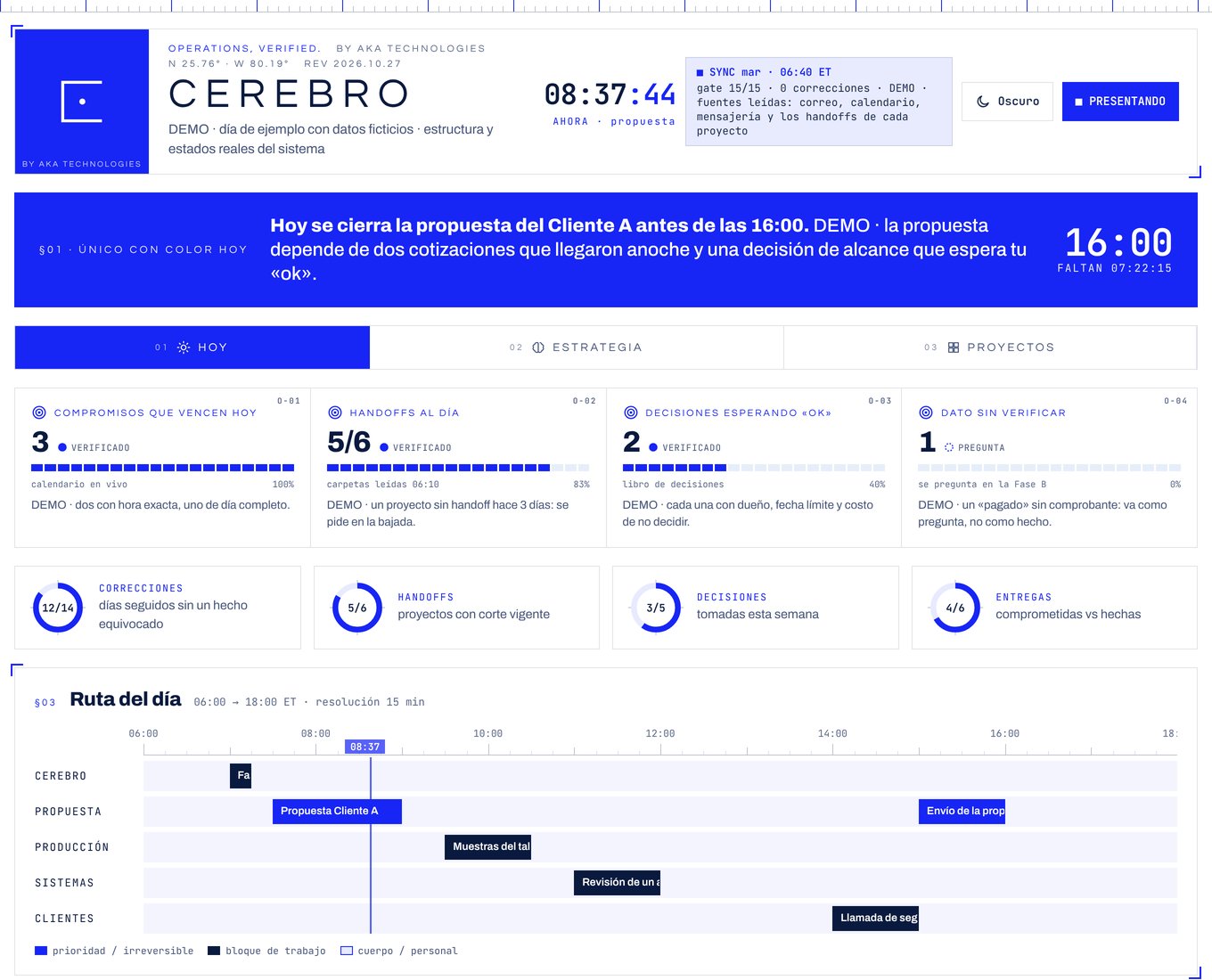
CEREBRO, MAGOS, FABI and MULTA are instruments of the method, not the method. Each is shown with its real status — because that is rule number three.
 CEREBROThe founder’s verified morning brief and operations board.In daily use
 MAGOSMulti-agent orchestration with per-brand isolation.In build
 FABIThe governed specialist agents MAGOS directs.In build
 MULTATolls, tickets and fines for car-sharing fleets.In design
Tell us where you think the value is lost.
Two minutes. Then pick a time for the first call. Or go straight to the calendar, or write to fabian@aka.holdings.
Your message is ready to send to fabian@aka.holdings — if your email app opened, press send. Now pick a time for the first call: